MIDDLETOWN, IOWA · NOVEMBER 19, 2026
The U.S. Army has postponed the planned detonation of degraded lead azide at the Iowa Army Ammunition Plant from Friday, November 20, to Monday, November 23. Acting Army Secretary Adam Telle said colder weather could make it more dangerous to wait. Read the Army’s November 19 announcement.
For people downwind, the Army’s public advisory focuses on lead-bearing dust. Its environmental assessment also tells crews to expect residual explosive material in debris at the site. A lead surface test can flag lead on an ordinary surface. Suspected explosive debris should be left to emergency responders.
LOCAL ADVISORIES
Where to find Iowa lead dust maps
Use the Army’s latest maps and instructions from local officials for decisions about sheltering, returning or cleanup. Wind forecasts can change between an announcement and the operation.
Army maps and community notices
Iowa public health guidance
EPA’s incident updates
Why the Army plans to detonate lead azide in Middletown
The Army found deteriorating lead azide at the Middletown plant in March. The plant paused operations for about two and a half weeks while specialists reviewed the hazard. Army spokesperson Justine Barati said the barrels had been stored there for more than 20 years. As the lead azide deteriorated, it became so sensitive to movement that officials judged transporting it too dangerous. KCRG’s report on the March shutdown · CBS Chicago’s account from the Army.
EPA’s emergency permit requires sampling and monitoring before, during and after the operation, as well as cleanup and public reporting. The sequence matters because lead can already be present in soil, dust and old paint. A measurement taken before the event gives investigators a point of comparison for what they find afterward. EPA’s permit notice.
Where lead dust can settle and how exposure affects health
The Iowa Army Ammunition Plant issued separate maps for lead in the air and lead dust that might settle on the ground. The first estimates where people could inhale particles. The second concerns surfaces downwind. The often-repeated figure of up to 20 miles wide came from a November 17 report on the earlier airborne forecast, which extended from Burlington to north of the Quad Cities. That was a forecast for the original date. It cannot tell a family how much lead, if any, will land on their windowsill on a different day. See the November 17 airborne lead and surface dust forecasts.
While particles are airborne, people can inhale them. After the air clears, dust on a porch, windowsill or toy can still reach someone’s mouth. A young child can swallow lead simply by touching a dusty surface and then eating with unwashed hands. Lead exposure often causes no obvious symptoms, even while it affects a child’s developing brain. It can interfere with learning, attention and behavior. CDC on the health effects of childhood lead exposure.
Adults can also be harmed. Long-term exposure increases the risk of high blood pressure and kidney damage. During pregnancy, lead stored in bone can re-enter the bloodstream and reach the developing baby. If you are concerned about a child’s exposure, tell their clinician where and when it may have happened and ask about a blood lead test. A surface result cannot tell you how much lead a person absorbed. World Health Organization on lead poisoning · CDC on blood lead testing.
Could unexploded lead azide travel with blast debris?
The Army expects explosive residue in debris at the detonation site. Its assessment discusses wider scattering of unreacted azide crystals in a separate scenario involving an accidental explosion. The distinction is important because a fragment that still contains lead azide can remain dangerous after it lands.
PLANNED OPERATION
Residue in site debris
For the controlled detonation, the Army expects broken concrete and soil from the demolition area to contain lead and residual explosive material. That is a hazard for crews who assess and remove the debris. The assessment does not identify intact lead azide at any off-site address.
ACCIDENTAL EXPLOSION
Possible wider scattering
In its analysis of what could happen if the stockpile were left in place and exploded accidentally, the Army describes unreacted azide crystals being thrown over a wider area. That scenario explains one risk of leaving the material in storage. The published lead-dust maps do not show where intact crystals would land.
EPA lists both reactivity and lead toxicity for the waste at Middletown. Unreacted lead azide in a fragment retains its explosive properties even after the dust has settled. Impact or friction can set off degraded material, so moving a fragment to get a closer look can itself be dangerous. A lead swab turning red would tell you only that the test detected lead. It could neither identify lead azide nor determine whether the object could be handled safely. Army environmental assessment, sections 3.5.4 and 3.6.3 · EPA’s explanation of the hazard.
If you encounter debris you suspect may be explosive, leave it where it is. Step away, keep others back and call 911 from a safe location. Give responders the location and describe what you saw. Leave all collection and testing to them. Guidance on recognizing and reporting suspected munitions.
How lead azide and sodium azide differ
The name “azide” covers several compounds. Lead azide in a suspicious solid raises an immediate explosives concern. Sodium azide, which some laboratories use as a preservative, also poses a poisoning hazard. It interferes with the body’s ability to use oxygen, putting the brain and heart particularly at risk. A laboratory handling a known sodium azide solution faces a different decision from a resident looking at unknown debris. CDC’s sodium azide fact sheet.
Which test screens for lead or inorganic azide?
For routine screening, start with the sample you actually have. A lead test can flag an accessible surface for follow-up. If you need a numerical dust result for an environmental investigation or clearance decision, a qualified professional can arrange a dust-wipe sample and laboratory analysis. Find an EPA-recognized laboratory for lead dust wipes.
DIRECT SURFACE TEST
SprayView™-Lead Spray Kit
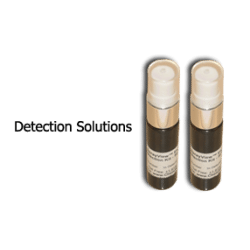
Choose the spray for a broader, suitable surface, such as a section of painted trim. A red response appears on the treated area when lead is detected. Each kit screens approximately 20 locations.
FOCUSED SURFACE TEST
SprayView™-Lead Swab Kit
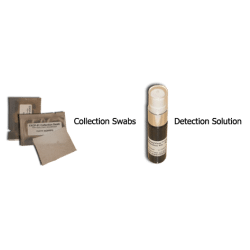
Choose the swab for a smaller test point, such as a latch or hinge. A red response on the swab flags lead at the sampled spot. On painted hardware, the result alone cannot tell whether the lead came from the finish or from settled dust. Each kit includes 20 swabs.
AZD-N2 Azide Detection Card for compatible liquids
For a laboratory or facility with a known liquid process sample, the AZD-N2 screens for inorganic azide at pH 5–8. Its documented response above 50 ppm is a dark brown to black color, typically within 1–2 minutes. The card gives a qualitative result. Do not use it to test blast fragments, dust or unknown powders.
Have a particular process-water or laboratory sample in mind? Send ChemSee its identity, expected pH and the decision the screen needs to support. Review AZD-N2 azide detection card specifications or request an application review and pricing.