Overview
Choose a formaldehyde detector for the sample you need to test: Formaldehyde ReactaStick™ (CS-DIP-FRM) for compatible prepared liquids, FRMSWB-04 swabs for surfaces, or FRM-KT1 dosimeters for gas monitoring. These formats serve different purposes.
Available Products
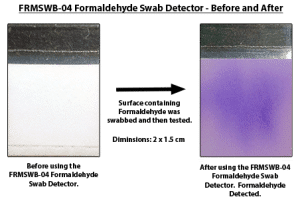

Swab Detectors for Testing Solid Surfaces
- Detects Formaldehyde on Fish, Fruit, Cheese, Meats and Other Surfaces Instantly
- Detects as low as Five Parts Per Million
- Qualitative (yes or no), Visual Analysis
- Selective Response
- Long Shelf-Life
Formaldehyde ReactaStick™ for liquid samples
CS-DIP-FRM replaces the FRM-04 liquid dipstick branding. A visible color comparison supports preliminary screening of compatible prepared liquid samples.
Choose 5, 10, 15, 30 or 100 tests.
Shop Formaldehyde ReactaStick · About formaldehyde liquid testing
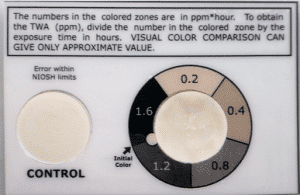

Dosimeters for Monitoring Formaldehyde Gas
- Detects Concentrations as low as 0.2 ppm*hr
- Perfect for Pathology Labs, Hospitals and other Occupational Settings
- Free In-Lab Quantitative Analysis
- Selective Response
- Long Shelf-Life
Demonstration Video
Our formaldehyde detectors allow for rapid, easy detection of formaldehyde in food and drink (PATENT PENDING).
Formaldehyde Information
Formaldehyde is a toxic material that can kill bacteria and viruses as well as damage human cells. Food manufacturers sometimes add Formaldehyde to foods such as fish, meats, milk, noodles meats, etc to extend its shelf-life. Many ordinary foods naturally contain small amounts of Formaldehyde however, excess Formaldehyde has been reported in many foods.
Although adding formaldehyde to foods is forbidden in many countries, some manufacturers still add it in particular if the food is expected to stay unrefrigerated for a while. Consumers of foods need to know if they contain excessive and dangerous amounts of formaldehyde. Inspectors of food need to know if formaldehyde was added purposely and illegally to the food.
Excess exposure to formaldehyde is known to increase the possibility of cancer and also cause breathing difficulties. Women in the early stages of pregnancy are also highly susceptible to exposure to Formaldehyde, as it is suspected to cause birth defects and other complications with early child development.