RON™ Multi-TIC Detector
The RON™ Multi-TIC Detector is a compact, non-electronic colorimetric detector designed for rapid screening of multiple high-risk Toxic Industrial Chemicals (TICs) using a single card.
Multiple sensing areas on the detector change color when exposed to specific chemical hazards. Results are interpreted visually by comparing the sensing areas with the reference colors printed directly on the card.
The RON™ requires no power source, electronic reader, liquid reagents, or droppers, making it well suited for rapid field screening by first responders, HAZMAT and CBRN teams, military personnel, civil agencies, and industrial safety personnel.
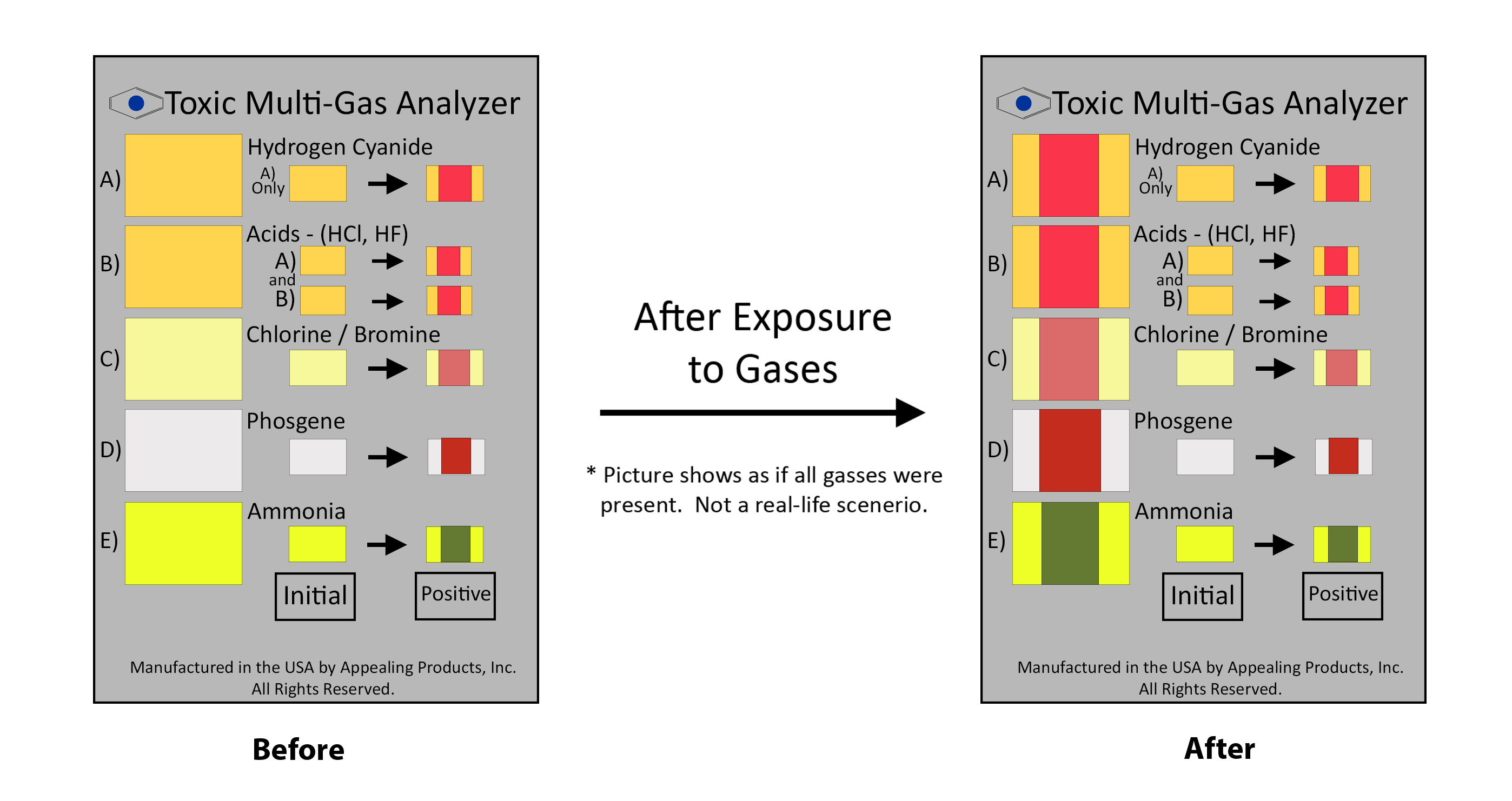
RON™ Multi-TIC Detector — visual color response before and after chemical exposure
What Does the RON™ Detect?
The standard RON™ detector contains sensing areas for five important Toxic Industrial Chemical categories:
- Acids
- Ammonia
- Chlorine
- Phosgene
- Cyanide
The center of each detection area produces a visible color response that can be compared directly with the reference colors printed on the card.
Detector Features
- Multiple TIC detection areas on a single card
- Immediate visual color response
- Semi-quantitative visual analysis
- No batteries or external power source required
- No electronic reader required
- No liquid reagents or droppers required
- Printed reference chart for interpretation
- Individually sealed tear-open packaging
- No routine maintenance required
- Compact and lightweight for field deployment
Custom TIC Configurations
The RON™ platform can be customized for organizations that need to screen for a different combination of Toxic Industrial Chemicals.
If your application involves specific TICs beyond the standard RON™ configuration, contact ChemSee with the chemicals of concern. Depending on the analytes and application, we can discuss a customized card configuration incorporating detection chemistries selected for your requirements.
ChemSee also offers individual toxic-gas dosimeters for a broader range of chemical hazards. Review our available TIC detection capabilities here:
View Toxic Gas Dosimeters & Additional TIC Detection Capabilities →
For government, military, industrial, HAZMAT, or other specialized programs, we encourage customers to tell us which chemicals are most important to their operation so we can help identify the most appropriate configuration.
Who Uses the RON™?
- First responders assessing possible chemical incidents
- HAZMAT and CBRN teams performing rapid TIC screening
- Military personnel operating in environments where chemical hazards may be present
- Medical and emergency personnel supporting chemical-exposure response
- Civil and government agencies responsible for emergency preparedness
- Industrial and commercial safety teams working around Toxic Industrial Chemicals
Rapid Chemical Screening Without Electronics
The RON™ is designed for situations where personnel need rapid chemical screening without the setup and logistical requirements of conventional electronic detection equipment.
Because the detector is self-contained, personnel can deploy it quickly in the field without instrument startup, calibration, batteries, or external reagents.
The visual color response can also be observed in relatively low-light conditions, helping support field use during both daytime and nighttime operations.
Compact & Lightweight
The RON™ detector measures approximately 4.25 × 3 × 0.125 inches and weighs approximately 8.9 grams without its protective packaging.
Its compact format allows detectors to be carried in emergency-response kits, vehicles, protective-equipment bags, security stations, and field equipment where rapid chemical screening may be required.
Simple Visual Interpretation
Each sensing area changes color in response to its target chemical category. The resulting color can be compared directly with the reference colors printed on the detector to assist with rapid hazard identification.
The detector does not require an electronic interface or specialized reader, helping simplify deployment and interpretation in field environments.
First Responder & HAZMAT Applications
The RON™ can support the initial assessment of environments where a Toxic Industrial Chemical release or exposure is suspected. Rapid screening can provide useful information for scene evaluation, protective-equipment decisions, emergency response, and follow-up testing.
CBRN & Emergency Response
The detector’s small size, self-contained chemistry, and independence from electronic equipment make it well suited for inclusion in CBRN preparedness kits and emergency-response procedures where rapid screening for selected TICs is required.
Request Pricing or a Custom Configuration
Tell us which chemicals are of concern, the intended operating environment, expected quantity, and how the detector will be used. ChemSee can help determine whether the standard RON™ configuration, a customized RON™ card, or another ChemSee toxic-gas detector is the best fit for your requirements.
Commercial, government, institutional, distributor, and international pricing is provided by quote.